
Groupe Scolaire Officiel de Butare, Indatwa n’Inkesha, is more than a historic campus in Huye District. Founded in 1929, GSO Butare is one of Rwanda’s oldest public schools, a place that has shaped generations of leaders and carried the reputation of academic excellence, discipline, and national influence. For much of the 20th century, the school was a symbol of elite education: highly selective and designed to prepare a small number of young people for administrative roles.
But Rwanda, and Rwanda’s education priorities, have changed profoundly in the last 30 years. And GSO Butare has changed with them.
In the years following the 1994 Genocide against the Tutsi, Rwanda set out to rebuild not only its institutions but its human capital. Education priorities turned toward equity, access, foundational learning, ICT literacy, and skills development. Schools that had a long legacy were called to evolve, opening their doors wider and modernising their teaching to meet a new national vision. GSO Butare is one of the clearest examples of that evolution.
Once centered largely on classical disciplines and rigid instruction, the school today hosts more than 1,000 students across O’Level and A’Level, reflecting a more inclusive, mass-education, and skills-oriented teaching system. What was once a school known for a small, highly academic elite is now a diverse learning community preparing students for a wide range of modern careers.
What Learning Looks Like Today
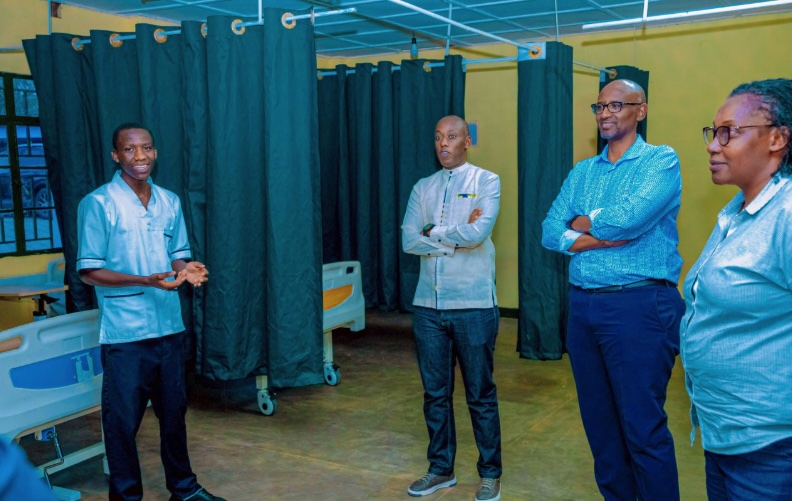
During a recent visit, the Minister of Education, Joseph Nsengimana, walked through classrooms, science labs, the school library, and smart rooms that illustrate this shift. Where learners in the 1980s and early 1990s relied almost entirely on chalkboards and memorisation, today’s students engage with:
- Digital learning tools and projectors
- Practical science experiments and research projects
- Competency-based, interactive teaching methods
- Group work that builds communication, critical thinking, and problem-solving
Teachers shared how they now structure lessons to build both knowledge and skills, supporting learners not only to pass exams but to succeed in higher learning and in Rwanda’s growing economy.
This shift is not cosmetic. It represents Rwanda’s broader transition to education for development, where schools are empowered to produce innovators, problem-solvers, and responsible citizens.
Even as it modernises, GSO Butare has retained the values that shaped generations of alumni: Hygiene, Culture, and Patriotism. These principles, once the markers of discipline and public duty, now support a new purpose: preparing young Rwandans to lead with integrity, responsibility, and pride in their identity.
The evolution of GSO Butare is one of many schools in Rwanda. It is a reflection of Rwanda’s education journey over the past three decades: inclusive access, moving from theory-focused instruction to competency-based, skills-driven learning, technology-enabled classrooms, and human capital development as a national priority.
When a school founded in 1929 can reinvent itself while keeping its character, it’s proof that Rwanda’s education reforms are not erasing history, but building on it.